Unicorn Dispatch LIVE · Episode Recap
Handing AI the Keys: What MCP Means for Your Attack Surface
SCYTHE CEO Bryson Bort sat down with Jake Williams to talk through the technology quietly reshaping security operations: the Model Context Protocol. The power is real, and so is the new attack surface.
Watch the episodeWith Bryson Bort and Jake Williams
Start Here
What MCP Actually Is
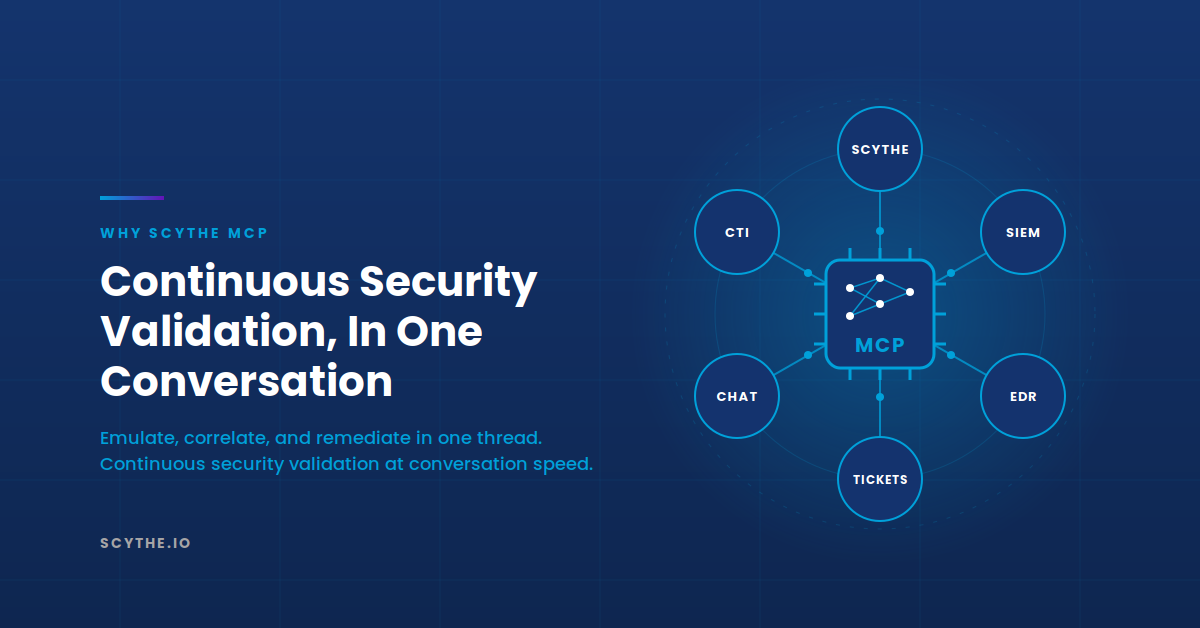
Think of it as the universal glue connecting AI agents to the tools they use. An MCP server exposes a set of tools, and an MCP client like Claude Desktop lets the model reason about which tools to call, in what order, to accomplish a task.
The Live Demo
The SCYTHE MCP Server, Running an End-to-End Purple Team
One request in, a fully correlated purple team result out.
Jake's Takeaways
Five Things to Carry Into Your Own MCP Work
The protocol hands you reach, and hands you the security bill with it.
The "S" in MCP Is Not Security
The protocol leaves security to you. Secure design patterns have to be layered on top.
Minimize Your Tools
Every tool you expose is another pair of scissors someone can run with. Expose fewer, and lock destructive actions behind hard, coded guardrails rather than prompt-based ones.
Threat Model for Capability Accretion
Agents combine tools in ways you did not anticipate. Bring an offensive mindset and ask how they could be chained for impact.
Watch the Lethal Trifecta
Sensitive data, untrusted input, and an exfil path. Cut one leg to contain the blast radius.
Name an Accountable Owner
As Jake put it, the fastest way to get a real conversation about agent risk is to ask who, specifically, is accountable for what the agent does.
The SCYTHE + Starseer Advantage
Using MCP's Power Securely
The power and the risk are the same mechanism: a model reasoning over tools it can chain on its own. Securing MCP is not about clamping the power down. It is about shaping the environment so the model can only reach for what you have already decided is safe. Make the safe path the only path, then prove it holds.
Expose the smallest tool set that does the job
Every tool is attack surface. At any given step there is roughly one right tool, so give the model few, and leave the dangerous ones off entirely.
Put your real controls in code, not in prompts
Prompt injection defeats anything written as a request. Guard destructive actions with hard, algorithmic checks, and run cross-tool checks, like blocking sensitive data from leaving, in the client before the tool ever fires.
Monitor and control AI at runtime ESSENTIAL
Static controls cannot see what AI does in the moment. A runtime monitoring and control layer, such as Starseer, watches all AI use across local models, MCP, and AI services and agents, inspecting requests and responses as they happen to detect and block malicious or out-of-policy behavior before it reaches a tool or leaves your walls.
Design against the lethal trifecta
Cut one leg, usually exfil, by building narrow, purpose-built tools, such as an email tool limited to preset recipients, instead of generic ones.
Prefer short-lived, single-purpose agents behind an orchestrator
One agent, one job, torn down after use. Between tools, sanitize and allow-list what passes, log everything the orchestrator sees, and deny anything outside the agent's stated intent even when permissions would allow it.
Authorize the agent, not just the user
Authenticate each agent and scope it to its task. Use an MCP gateway to block calls that are technically in scope but wrong, and treat non-human identity as the fastest-growing identity surface. Fix your human on and offboarding automation before you take it on.
Keep a human in the loop for high-risk writes
Do not let an agent auto-push blocking rules or detections. Route them to a ticket so change control still applies.
Name an accountable owner
The fastest way to get serious oversight is to put one person's name on what the agent does.
Continuously validate that it all holds ESSENTIAL
These controls are assumptions until something tests them. Continuously emulate adversarial MCP orchestration and agent abuse against your own stack with SCYTHE, and measure what actually gets prevented, detected, and contained. That is how "we think it is secure" becomes "we can prove it."
The Power of MCP, With Security Built In
You do not have to choose between moving fast and staying safe. SCYTHE emulates adversarial MCP orchestration and agent abuse so you know exactly where you stand, and Starseer monitors and blocks malicious or out-of-policy AI behavior at runtime. Together they give teams the confidence to take full advantage of AI and MCP, securely.
Jake's Closing
Do Not Be Afraid of MCP. Embrace It, But Build It Securely.
Be the person who says "yes, and here is how we do it safely," not the person of no.
Watch the full conversation Unicorn Dispatch LIVE · Act Before You Need to React.
Latest Posts