Agentic AI frameworks are now running real intrusions at machine speed. The techniques are familiar. The clock is not.
In September, I wrote that AI gave attackers speed, not new techniques, and that your detections now have a shelf life. That post focused on one espionage actor using AI agents to rebuild malware until host security stopped seeing it. Two months later, Google Threat Intelligence Group (GTIG) and Mandiant are documenting the next step: multiple threat actors running large parts of the intrusion lifecycle through open-source, multi-agent AI frameworks.
The frameworks have names now. ARTEX, PentAGI, CAIRN, and custom harnesses have shown up in Mandiant incident response engagements since late August. Agents handle reconnaissance, privilege escalation, lateral movement, and exfiltration prep with little human direction. The tempo argument we made in September is no longer a forecast. It is in the case files.
What Mandiant and GTIG Found
ARTEX is an autonomous, multi-agent penetration testing and command-and-control platform. Its original GitHub repository was taken down following widespread abuse, but forks and a commercial version continue to circulate. Both financially motivated extortion groups and suspected PRC-linked espionage groups have adopted it, targeting government, technology, manufacturing, semiconductor, and telecommunications organizations.
The tradecraft is familiar. Using stolen credentials, ARTEX mapped cloud permissions, Kerberoasted service accounts, used DCSync to extract the krbtgt key and cloud AD-sync credentials, poisoned MySQL logs to deploy JSP webshells, and enumerated more than 110,000 Active Directory objects. These are established MITRE ATT&CK techniques defenders have been working against for years.
What's changed is the speed and adaptability. Individual ARTEX execution sequences ran in bursts of 2 to 25 seconds. Wiz observed an actor progress from initial account compromise to deep system access in roughly four hours, and in one instance, just 15 minutes. When an action failed, the agents analyzed the error, adjusted their approach, and tried again within seconds.
Detection Is Not Disruption
Mandiant makes a point every CISO should bring to their next board meeting: catching an attack in time does little if your response can't stop the attacker from reaching the objective. When an intrusion runs in minutes, the gap between an alert firing and an analyst acting is the attack window.
That is why validation has to cover the full chain: prevention, detection, alerting, and response. A green dashboard tells you a rule exists. It does not tell you whether your team can contain an agent that pivots every few seconds.
Test the C2, Again
In September, we argued that the command-and-control channel is the one part of an operation the adversary cannot make disappear. ARTEX makes the point for us. In one intrusion, it sent command output back across 491 rotating webhook.site URLs using nothing more than native curl.
If your validation only asks the host whether the host was compromised, that traffic is invisible to it. Score every technique as logged, alerted, or blocked on the host and on the network, and treat the difference between the two as the most valuable result of the exercise.
The Noise Is a Gift. Use It While It Lasts.
Today's agentic frameworks trade stealth for speed. They generate rapid bursts of activity, iterate through trial and error, leave recognizable artifact names, and phone home to webhook services. In principle, this is detectable. In practice, it is only detectable if your telemetry, baselines, and correlation rules actually work.
GTIG expects sophisticated, fully autonomous operations with increased stealth within the next three to six months. Organizations that tune and validate detections for today's noisy version will be ready for the quieter one. Organizations that wait will find their gaps during an incident.
Mandiant's Five Layers Are Claims Until You Prove Them
Mandiant's defensive guidance is organized into five layers: protect the control plane, restrict identities and keys, harden configurations and reduce attack paths, protect applications, and detect behavioral and volumetric change. Each is sound. Each is also an assumption until it is tested.
Is your Kudu or SCM endpoint actually restricted? Does your SIEM flag permission probing followed by storage enumeration and a callback to a new external service as one sequence, or as four unrelated, legitimate-looking events? Vulnerability scanning tells you individual weaknesses exist. It does not tell you whether an automated adversary can chain them into domain compromise.
Running the Purple Loop at Machine Speed
In September, we laid out the purple loop: Emulate, Observe, Score, Fix, and Re-run. It is how teams mitigate ARTEX-style risk today, using the same tradecraft Mandiant documented.
| ▪ | Emulate. Turn the TTPs and sequences in this report into an emulation, and run it safely against your production controls, from valid-credential cloud probing through Kerberoasting, DCSync, and webhook callbacks. |
| ▪ | Observe. Pull what your stack actually recorded for each step, on the host and on the network. |
| ▪ | Score. Give each step a logged, alerted, or blocked verdict, and measure your response time against the 15 minutes to four hours Wiz observed. |
| ▪ | Fix. Deploy detections for the gaps, tune the sequences that fired as noise, and harden the configurations and identities the emulation exploited. |
| ▪ | Re-run. Prove the fix holds, and repeat as identities, permissions, and infrastructure change. |
The loop doesn't run once. It runs as four concurrent tracks, each at the tempo its job demands.
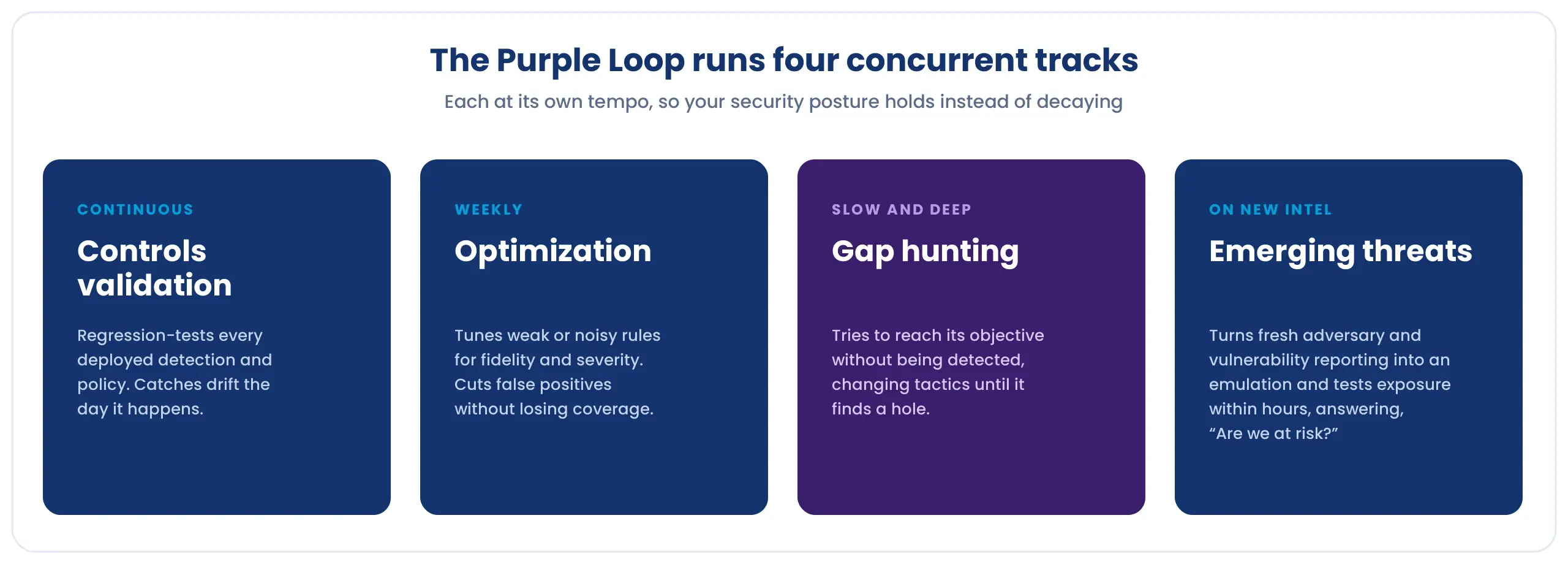
Agentic frameworks put pressure on all four at once. Controls validation runs continuously, because identities, permissions, and policies drift every day, and an agent will find a path the day it opens. Optimization runs weekly, tuning detections so ARTEX-style bursts surface as one high-fidelity sequence rather than a flood of low-confidence alerts. Gap hunting runs slow and deep, emulating an adversary that changes tactics until it finds a hole, which is exactly what these frameworks do and how you get ahead of the stealthier operations GTIG expects next. Emerging threats runs on new intel, turning a report like Mandiant's into an emulation within hours so you can answer “Are we at risk?” before an agent answers it for you.
With the SCYTHE platform and the SCYTHE MCP server, an AI agent can drive that loop as one connected workflow, from ingesting threat intelligence to re-running the campaign. Your defenses get validated at the tempo you are attacked, not on the calendar of your next assessment.
Where to Start
Take the sequences Mandiant documented and test them in your environment this week: valid credentials followed by rapid cloud permission probing, Kerberoasting into DCSync, database-to-OS pivots through log poisoning, and outbound callbacks to webhook services. If your controls catch and stop each step, you have proof. If they don't, you have a prioritized list to fix before an agent finds it for you.
The adversary's clock just got faster. Your validation clock needs to match it.
Act Before You Need to React
Close Your Loop Before Their Agents Do
See how SCYTHE turns threat intelligence like this into running emulations, scores logged, alerted, or blocked on the host and on the network, and turns every gap into tracked, owned remediation.
Request a DemoSource: Google Threat Intelligence Group and Mandiant, ARTEX and Friends: Enter Agentic Offensive Frameworks, October 30, 2026.
Previously: Same Techniques, New Tempo: Why Your Detections Now Have a Shelf Life