Gartner named Autonomous Exposure Remediation a top strategic technology trend for 2027. The hardest part of that vision is not finding exposures. It is deciding what to fix, proving the fix held, and buying teams the time to patch without leaving the door open.
Every security team lives with the same quiet math. The number of vulnerabilities disclosed each month is larger than the number any team can test, schedule, and patch in that same month. The backlog does not clear. It grows. And the guidance to "patch everything, now" has never once survived contact with a real change window, a regression test, or an application owner who cannot take downtime this quarter.
Gartner put a name to the shift away from that broken model. In its Top Strategic Technology Trends for 2027, the firm introduced Autonomous Exposure Remediation, or AER: the integrated use of AI and automation to find, prioritize, and fix security exposures across the digital estate at machine speed, rather than letting them sit in a queue for weeks.
We think the vision is right. We also think the hardest and most valuable part of it is not the part most of the market is racing toward.
What AER actually requires
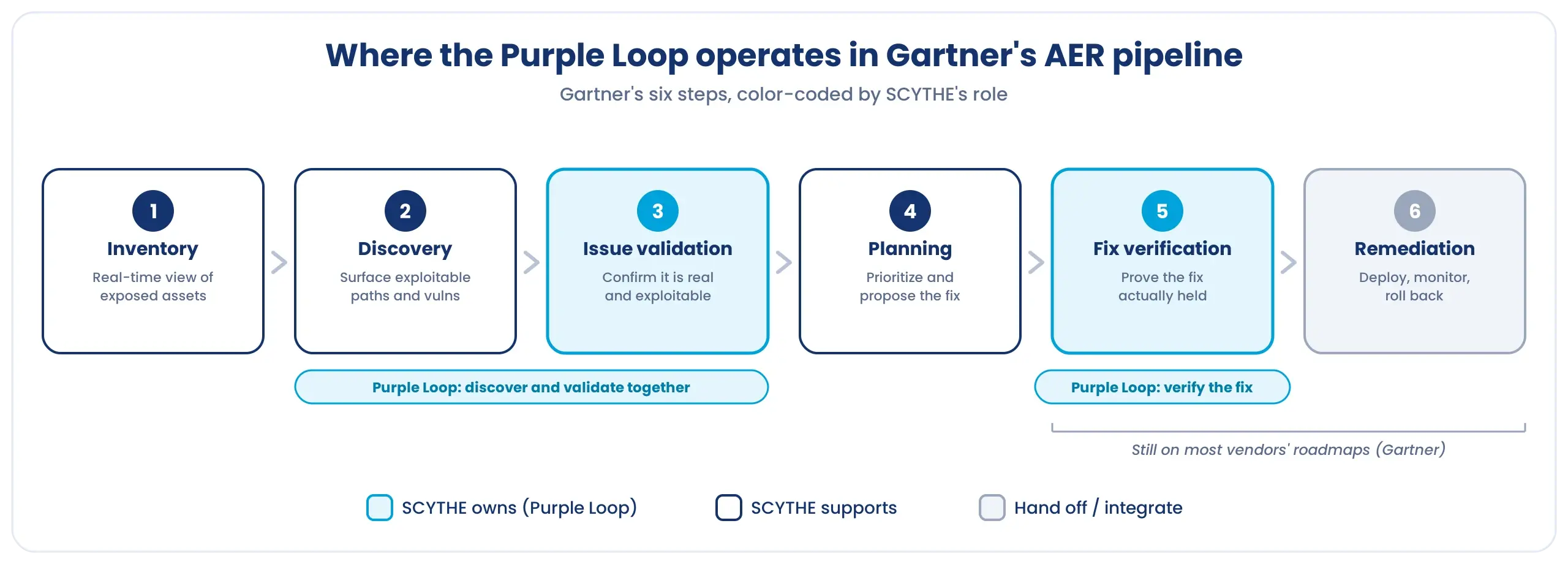
Gartner describes AER as a progression, not a single feature. It moves from inventory and discovery, through validating that an exposure is real and exploitable, to planning a fix, verifying that the fix works, and finally deploying it with the ability to roll back. Two details in that progression matter more than the rest.
First, Gartner places validation at the foundation. Before anything gets fixed, AER has to confirm that an exposure is both reachable and dangerous, and the research names adversarial exposure validation as the active way to do it. That is not a side capability. It is the thing that keeps automation from flooding teams with fixes that do not matter.
Second, Gartner is candid that the last two steps, verifying the fix and safely deploying it, are still on most vendors' roadmaps, and that full, hands-off autonomy is several years out. The trust required to let a machine push a change into production, and to prove that change worked, does not exist yet in most tools.
So the race is toward automated fixing. But the open ground, the part the market has not built, is validation and verification. That is exactly where the Purple Loop lives.
The Purple Loop does more than validate once
This is where our model and the linear AER pipeline part ways. Gartner describes AER as a sequence run once per exposure: inventory, discover, validate, plan, verify, remediate. That is the right set of steps. It is the wrong shape. Exposure is not a queue you drain once. Controls drift, rules go noisy, new intelligence lands daily, and adversaries, increasingly using AI, never stop probing for the one gap you have not closed yet.
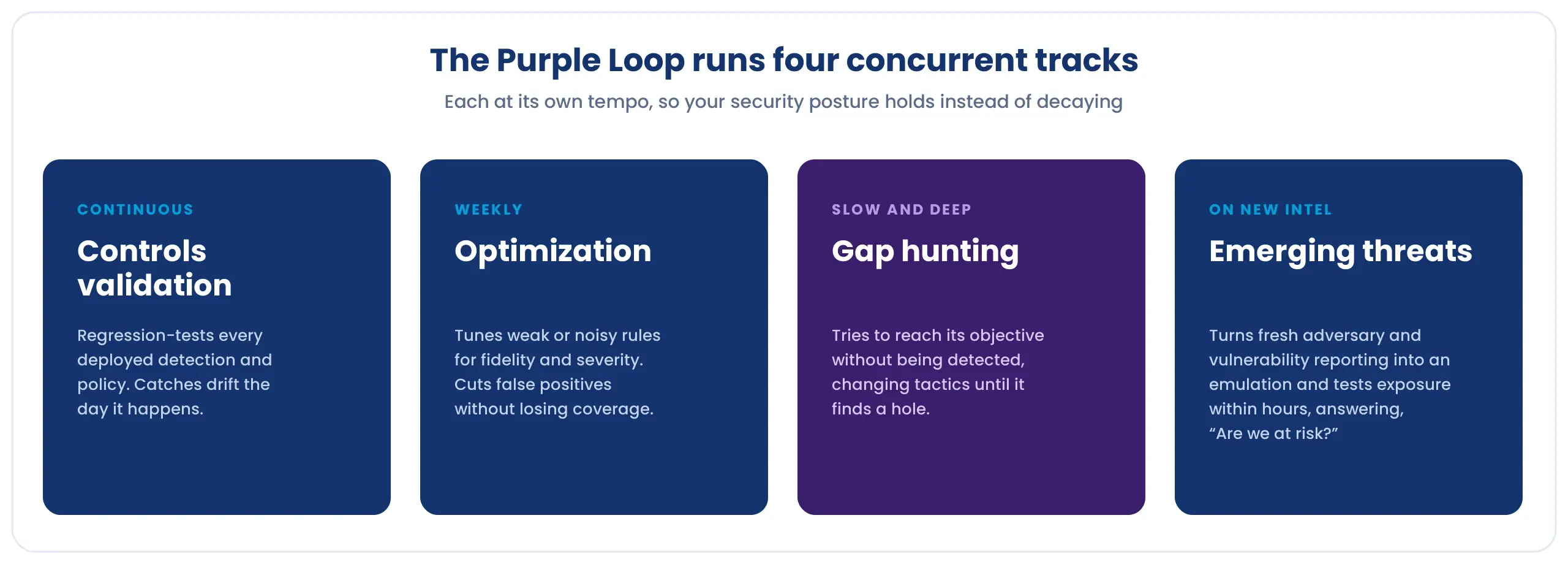
The Purple Loop is built for that reality. It runs four concurrent tracks, each at its own tempo, so your posture holds instead of decaying the moment a pipeline finishes:
▪ Controls validation, continuous. Regression-tests every deployed detection and policy, and catches drift the day it happens.
▪ Optimization, weekly. Tunes weak or noisy rules for fidelity and severity, cutting false positives without losing coverage.
▪ Gap hunting, slow and deep. Works toward an objective without being detected, changing tactics until it finds a hole, the same way a real adversary does.
▪ Emerging threats, on new intel. Turns fresh adversary reporting into an emulation and tests exposure within hours, answering the only question leadership actually asks: are we at risk?
AI orchestration is what lets all four run at once, at machine speed, without a team babysitting each pass.
This is the heart of our point of view. AER, or at minimum the adversarial exposure validation that anchors it, has to do more than find and fix an exposure one time. It has to assess what is new, maintain and optimize what is already deployed, and actively hunt for the gaps an adversary will reach for, including the gaps that AI-accelerated attackers will surface faster than any human review can keep up with. A single validate-and-verify pass tells you that you were secure at one moment. The Purple Loop tells you that you still are.
Together those four tracks deliver the two things Gartner says the market has not built: the validation foundation that confirms an exposure is real and worth acting on, and the fix verification that confirms a control or patch held. The difference is that the Purple Loop delivers both continuously, not once.
The twist: patching becomes a choice again
Here is where our point of view diverges from "automate the patch."
A behavioral detection is not only a log or an alert. It can block. A detection that blocks the technique an exposure relies on is a compensating control that closes the exploit path, not one that watches it go by. And unlike a patch, a block is surgical and reversible: you can disable it in seconds, with no code change, no rebuild, and no rollback of a software release.
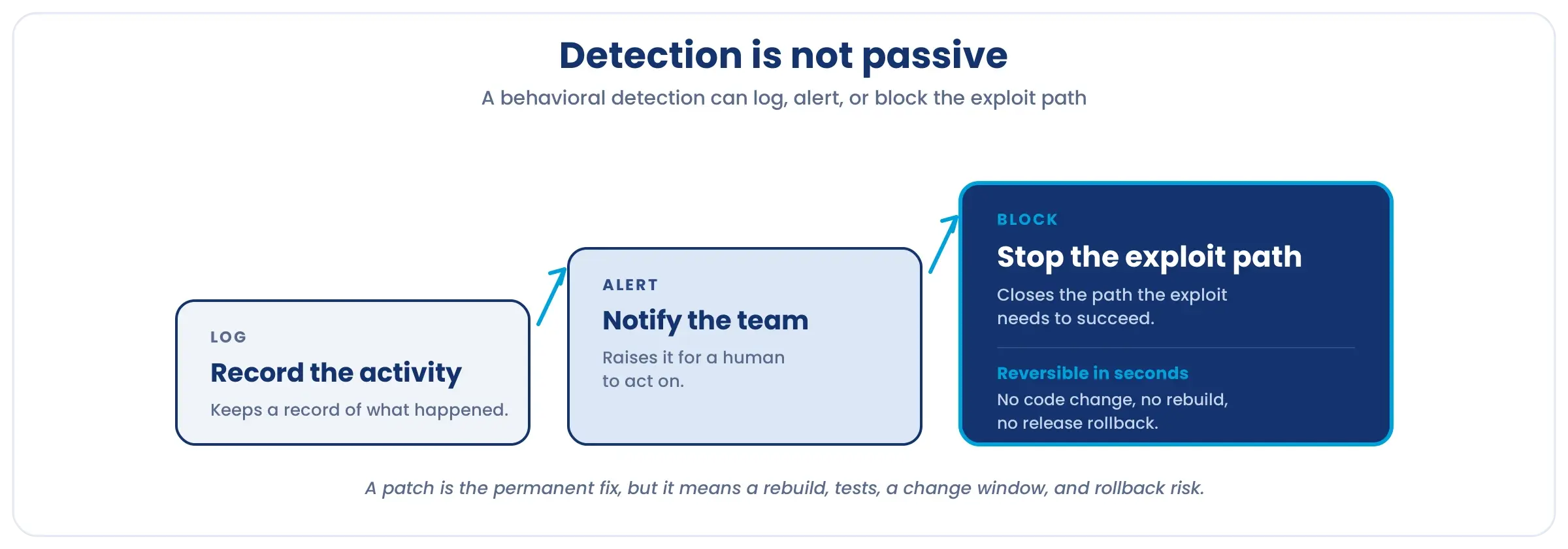
That changes the economics of the fix gap. If the Purple Loop can deploy a behavioral control and then prove it catches the technique and its variants, a team no longer faces a binary of patch now or stay exposed. They get a third option: contain the threat behaviorally today, and schedule the permanent patch for when it is safe to ship.
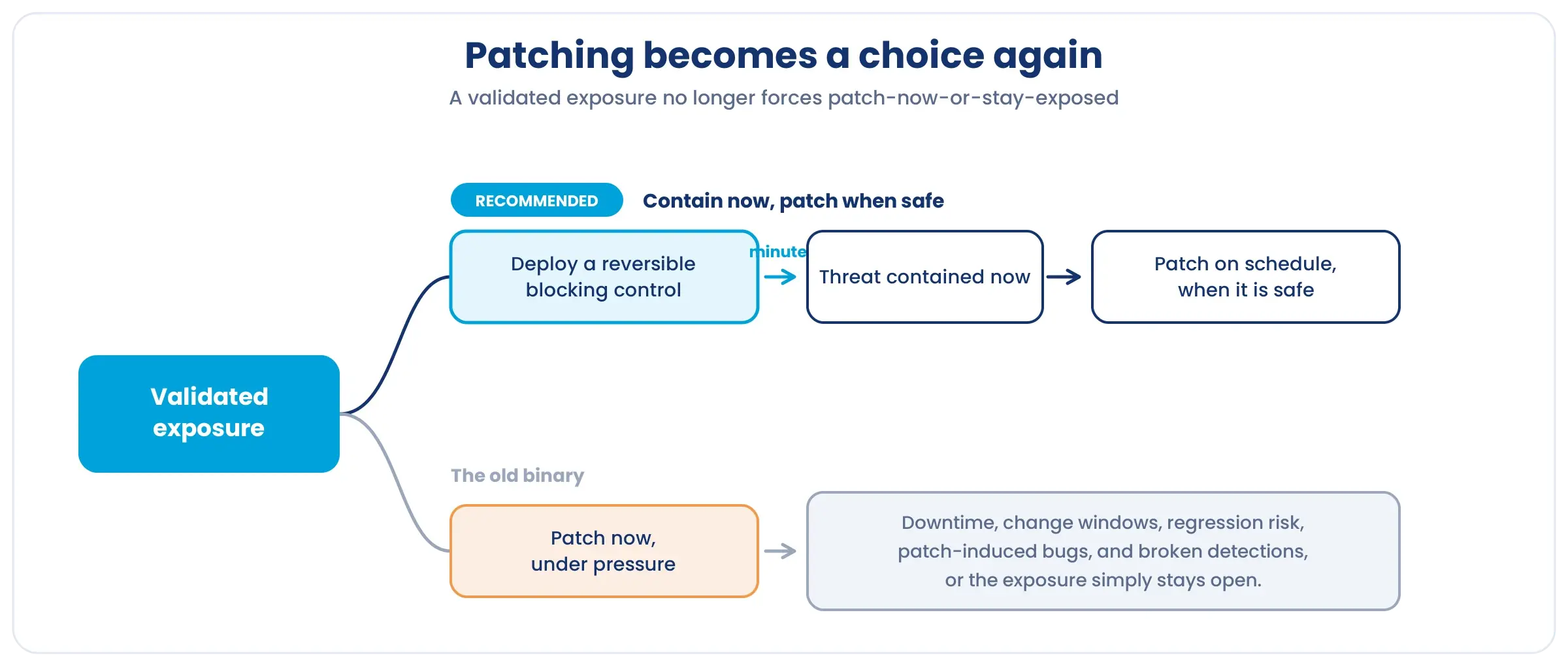
This is not an argument against patching. Patching is essential, and it is the only permanent fix. It is an argument against the fantasy that every patch can land immediately. Patching is taxing: it consumes test cycles, change windows, and downtime. Patching is also risky in ways teams rarely budget for. A patch can introduce new bugs, open new vulnerabilities, and quietly break the very detections you were relying on, because when the software changes, the behavior your detection was tuned to changes with it.
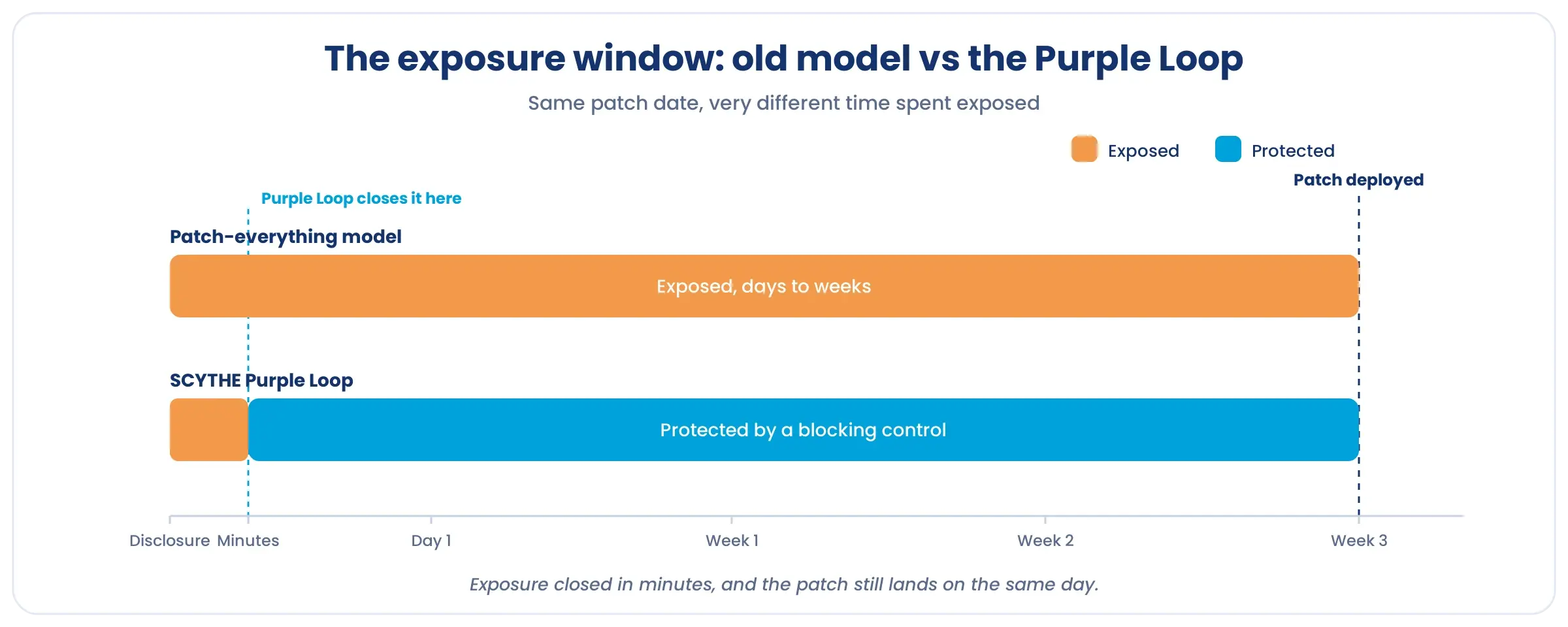
The Purple Loop earns its keep on both sides of that decision. Before the patch, it proves a blocking control is good enough to safely defer the patch to the next window. After the patch, it reruns the emulation to confirm the patch did not silently open a coverage gap. Either way, you are operating on evidence instead of hope.
Validation is the moat
None of this works on assertion. A generic blocking rule gets left in monitor mode because no one trusts it to run inline without breaking production. A rule that SCYTHE has proven fires on the technique and its variants, with a measured false positive rate, is one a team can turn on. Verification is what makes a block deployable, and it is what makes deferring a patch defensible to an auditor, a regulator, or a board. It moves the conversation from "we were watching" to "we stopped it, and here is the proof."
Two honest conditions come with the position. Risk-based patch sequencing is only as good as the prioritization underneath it, so exploitability and reachability have to drive the ranking, or "defer the rest" becomes "defer blindly." And the enforcement happens in your existing controls, your EDR, your firewall, and your IPS, so the Purple Loop's job is to tell those controls precisely what to block and to prove it worked, not to replace them.
Design for AER now
Gartner's advice is to start building toward AER today rather than waiting for full autonomy to arrive. We agree, and we would add a sharper version: start with the capabilities that create trust, because trust is the real bottleneck. Validation that an exposure matters. A compensating control that can block, not only observe. Verification that the control held, and that the eventual patch did not break anything on its way in.
That is the Purple Loop. It delivers the foundation and the verification that AER depends on, and it does it continuously rather than once, which is what gives security teams something the patch-everything mindset never could: the freedom to patch what matters, when it is safe.
Design for AER Now
See the Purple Loop validate, verify, and buy back your patch window.
Prove which exposures matter, deploy a behavioral control that blocks, and confirm it held, continuously.
Request a DemoLatest Posts