Product
Continuous security validation is the practice most SOCs believe in and almost none actually run. The intent is there. The cadence is not. SCYTHE MCP closes that gap by moving the entire validation loop into an AI client that is already connected to your SIEM, your EDR, your tracker, and your chat platform.
Continuous security validation breaks at the seams, not in the middle
Every mature validation program runs the same five steps. Pick a threat. Emulate it on a real host. Pull what the SIEM and EDR actually saw. Decide whether the control logged, alerted, or blocked. Turn the gap into work someone owns.
None of those steps are hard. The handoffs between them are. The operator runs the emulation in one console, exports a timestamp range, walks it over to the SIEM, eyeballs the correlation, writes the finding into a slide, and files a ticket in a third system. Each seam costs a person, a context switch, and a day. That tax is not unique to validation. Writing about the AI SOC market, Olivia Lomax points to Microsoft and Omdia research finding that many SOCs spend at least a fifth of their week simply aggregating and correlating information across systems. Validation pays that same tax, just less often.
That is why most programs validate over weeks. Not because weekly is the right cadence for a control set that can change daily, but because the coordination tax makes anything faster unaffordable. Continuous security validation fails on logistics, not on belief.
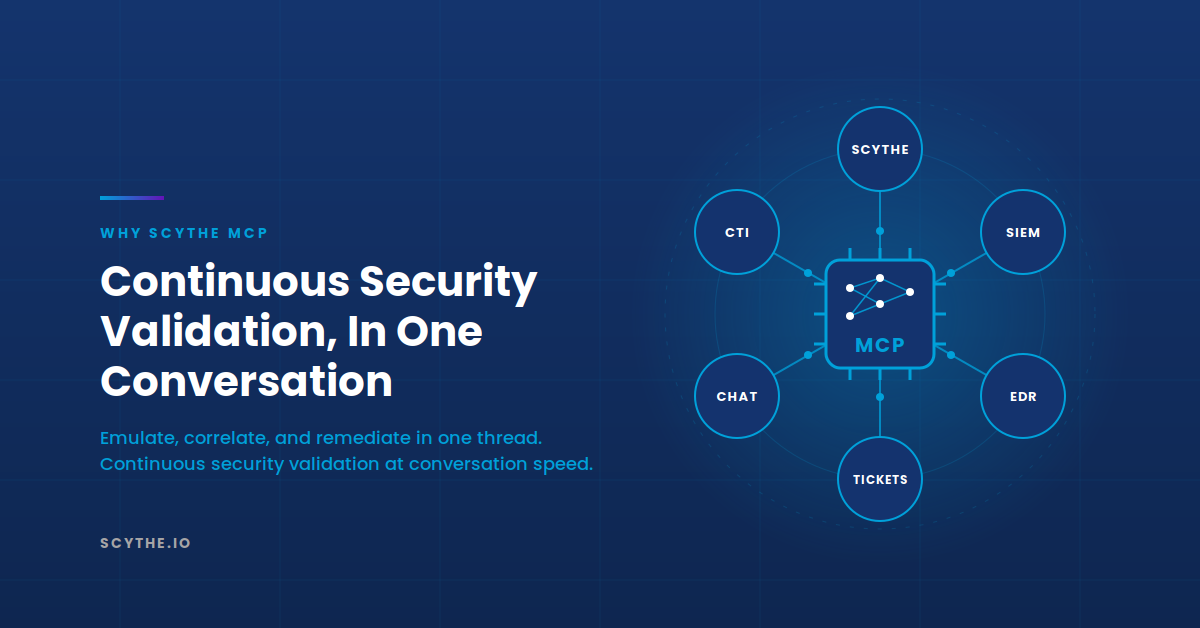
SCYTHE MCP removes the seams. The platform publishes its capabilities as tools to an AI client, so the entire loop runs in a single conversation, alongside every other security tool you have connected.
What MCP actually is
The Model Context Protocol is an open standard for exposing an application's functions to an AI assistant. The assistant does not scrape your UI or guess at an API. It reads a declared catalog of tools, each with defined inputs, permissions, and effects, then calls them on your behalf under your identity and your role's scopes.
SCYTHE ships an MCP server that exposes the platform this way. Threat intelligence, the threat library, test creation and execution, agent inventory, SIEM and EDR correlation, detection coverage, exposure tracking, exercise management, and reporting are all callable from a client you already use. Connect Claude Desktop, Claude on the web, Codex, or Copilot, sign in, and the platform is available in natural language.
Two properties make this different from a chatbot bolted onto a product.
It runs as you
Tool calls inherit your SCYTHE identity, workspace, and role permissions. The assistant cannot see or do anything your account cannot.
Every tool declares its blast radius
Read-only tools are marked observe. Tools that create or modify platform objects are marked mutate. Tools that execute adversary behavior on a live host are marked destructive and require an explicit agent and target. You always know which side of the line a request falls on before it runs. See Tool Catalog and Blast Radius.
The full loop, in one thread
The multi-tool case is where the value compounds. A single connected client turns five tools into one workspace, and the loop closes without a human carrying data between systems.
A detection engineer ships a new rule for credential access on Windows endpoints. In one thread:
- Intelligence. Ask what is trending and which actors are exercising the relevant techniques. SCYTHE returns live CTI and maps it to ATT&CK.
- Emulation. Run the matching threat against a named lab host. SCYTHE builds the test, assigns it to the agent, and reports per step outcomes as they land.
- Correlation. Sync the SIEM and EDR connectors and pull the correlated security events for that run. The assistant reports what was logged, what alerted, and what was blocked, with the reasoning behind each verdict rather than a raw event dump.
- Adjudication. Where the platform cannot resolve a verdict automatically, record the manual assessment in the same thread so the coverage record stays accurate.
- Remediation. Open a tracked exposure against the test for anything the stack missed, assign an owner and severity, file the corresponding ticket in your tracker, and post the summary to the SOC channel.
- Reporting. Generate the write-up from that same run: techniques executed, verdicts recorded, exposures opened and owned. One artifact for the detection engineering review, the control owner, and the executive summary, grounded in platform data rather than reassembled by hand.
Five systems. One conversation. Minutes, not a sprint.
One platform, five teams, one evidence base
Adversarial exposure validation generates the evidence that five different functions need to do their jobs, and MCP puts that capability directly in each of their hands. The console remains the operator's workbench. The endpoint extends the same capability into the tools the rest of the security team already works in, so threat intelligence, offense, detection engineering, control ownership, and exercise leadership all draw on one platform, one permission model, and one record of what has been validated. Each team asks in the language of its own function and gets an answer built from the same execution data.
Threat intelligence: from advisory to evidence the same day
An advisory publishes naming an actor and a technique set. Today the intel team writes an assessment about whether it applies to the organization. With an MCP endpoint they can answer it instead. Pull the actor's techniques, run the relevant behaviors against a representative host, read what the stack did, and publish the brief with an evidence column: this one is blocked, this one alerts only, this one is invisible to us. Applicability stops being an estimate and becomes a result.
Red team: hand off the rehearsed, keep the novel
Re-running techniques the team has already proven is the first work cut when an engagement runs long. Delegating that known set to the assistant means coverage breadth stops competing with engagement depth. Operators spend their time on tradecraft the library does not have yet, then contribute it back as a threat definition anyone can rerun.
Detection engineering: a unit test for the rule being written
Write the logic, fire the technique, read what the SIEM and EDR did, tune, fire again, all without leaving the thread the rule is being drafted in. The gap between writing a detection and knowing whether it fires collapses from a sprint ticket to a few minutes. That changes how many rules a team is willing to attempt, and how many it is willing to retire.
Defensive stack owners: validate during deployment, not after the incident
An EDR policy moves into blocking mode. An exclusion is added for a noisy line-of-business application. A firewall rule opens for a migration. Today the owner trusts the vendor documentation and finds out later whether the change did what it was supposed to do. With the loop short enough to fit inside a change window, the owner runs the techniques the control is meant to stop before the change ships. Finding a gap while the change ticket is still open is a tuning task. Finding it during an incident is a post-mortem.
Exercise leads: a facilitator, not a scribe
Build the purple team or tabletop exercise, seed injects from a scenario or from live intelligence, score detection response against HSEEP ratings as the room works through it, and generate the after action report before people leave the call. The exercise stops being a week of preparation followed by a month of write-up.
None of this loosens control. Every one of those people is still bounded by their SCYTHE role, and every action they take writes to the same record. What changes is that the evidence stops being locked behind an operator's login.
Where the SOC gains compound
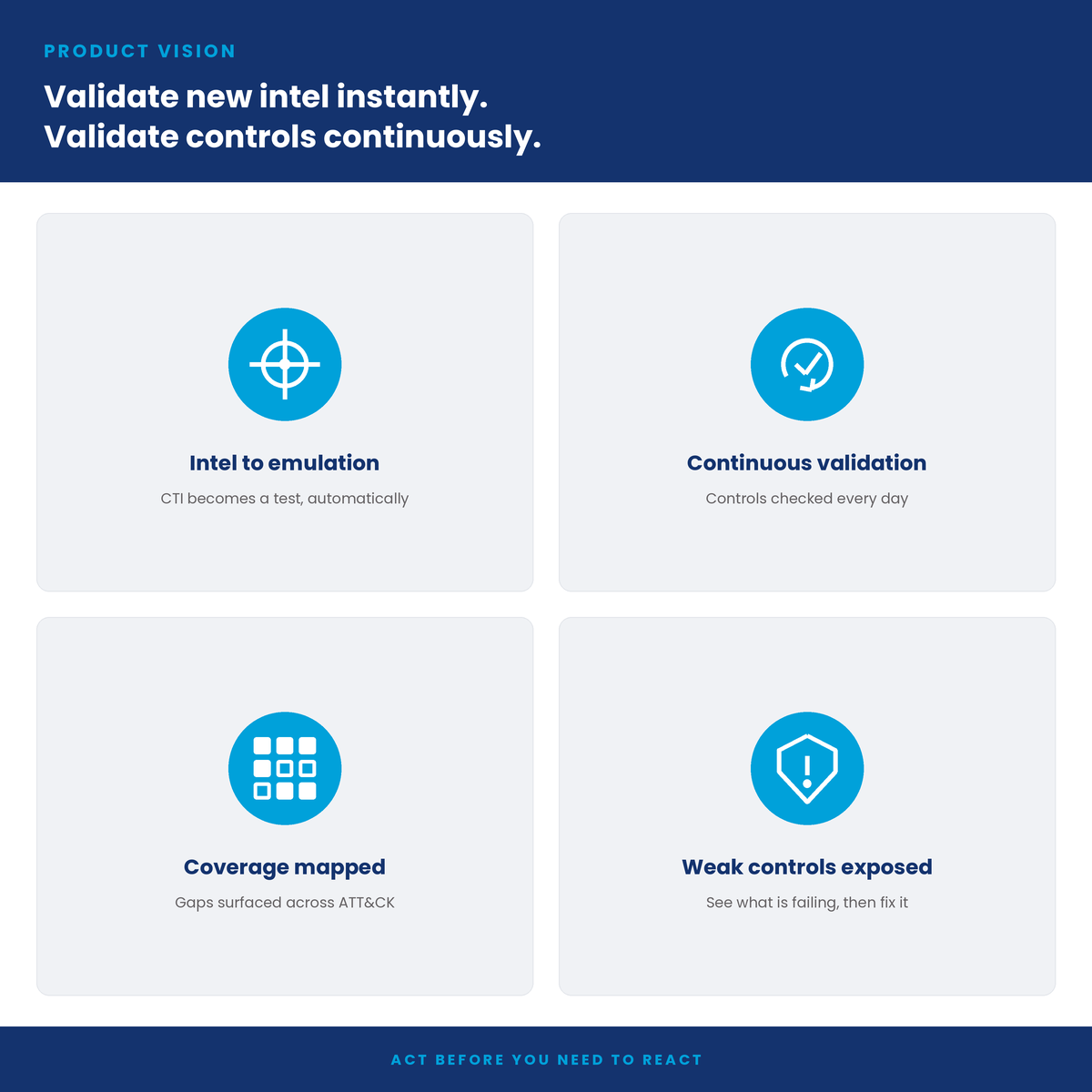
Continuous security validation only pays when the cycle is short. Once it is, things start improving that a quarterly program never touches.
Coverage stops being a guess
Ask which ATT&CK and ATLAS techniques have not been tested in the last 90 days and get an answer from execution records, not from a spreadsheet someone maintains by hand. Gaps surface as data.
Silent rule failures get caught in hours or days, not weeks
Detection logic breaks quietly. A log source changes format, a field gets renamed, an agent policy is tightened, and the rule that fired last month now matches nothing. Nobody gets an alert when an alert stops working. Re-running the technique the same day surfaces the regression while someone still remembers what changed.
Control drift becomes an event you validate, not a risk you carry
An EDR upgrade rolls across the fleet. A firewall policy is loosened for a migration. A new SaaS host joins the environment. Each of those is a reason to re-validate, and each of them used to lose to the coordination cost. When asking is cheap, validation becomes a reflex tied to change, which is when detection coverage is most likely to have moved.
Alert-only coverage stops being mistaken for protection
Most stacks have a long tail of techniques where the control alerts and nothing blocks. That distinction only shows up when you execute the behavior and read what the SIEM and EDR actually did. Continuous validation turns that tail into a ranked, evidenced list instead of an assumption.
Mean time to detect improves against techniques you have already rehearsed
Every validated technique produces a known-good telemetry baseline: what the behavior looks like, which sources carry it, what fired and when. Analysts triaging the real thing are working from a pattern they have seen before rather than from first principles.
Security spend gets defended with evidence
When the board asks whether the stack works, the answer is a coverage record from execution data: techniques tested, controls that blocked, controls that alerted, gaps with owners and dates. Every one of those findings traces back to a specific test, a specific host, and the SIEM's own account of what it saw. That is a stronger position than a maturity score, and it is the difference between funded remediation and a debate.
Validation is what makes an AI SOC trustworthy
In The AI SOC Market Has a Category Problem, Olivia Lomax argues that AI SOC, agentic SOC, MDR, hyperautomation, and next-generation SIEM have converged on the same claims, and that the more useful question for a buyer is how much of the security operation they still have to run themselves. Measure vendors by operational burden removed, not by how autonomous the agent looked in the demo. Three of her points land directly on what continuous security validation is for.
An AI analyst can only reason over the telemetry you actually have
Lomax makes the point that AI does not solve the visibility problem security teams already had. An agent that queries faster than a human still cannot reason over data that was never collected, and when the telemetry is incomplete it reaches the wrong conclusion faster and across more investigations. Emulation is how you find out. Execute a technique on a named host at a known minute, then ask what the SIEM recorded. Nothing there means you found a data gap on your own schedule rather than during an incident. Continuous validation tests the layer the AI SOC depends on, not just the rules sitting on top of it.
Investigation quality needs an answer key
She argues that investigation quality deserves more scrutiny than investigation speed, because a polished summary can be convincing and still be wrong. Grading that is hard, since real incidents rarely arrive with ground truth attached. Emulation supplies it. You know which technique ran, on which host, at which timestamp, and what the telemetry should look like. Point the AI investigation at activity you generated and its verdict becomes measurable: what it caught, what it missed, and what it closed confidently that it should not have. That is a false negative rate rather than a demo impression.
The autonomy conversation is a blast radius conversation
Lomax notes that the industry spent years building approvals and separation of duties around actions like isolating a host or disabling an account, and is now deciding which of those to hand to an agent. SCYTHE takes the same position on the offensive side of the loop. Scope is inherited rather than granted, so connecting a client creates no privilege your role did not already carry. Destructive tools will not fire against a vague target; they need a real agent on a real named host. Tests, verdicts, and exposures write to the same system of record the console writes to, which makes the assistant another interface to the truth rather than a shadow copy of it. Autonomy is useful in proportion to how explicit its boundaries are.
Credit to Olivia Lomax for the framing. Her piece is worth reading in full: The AI SOC Market Has a Category Problem.
Why MCP-enabled headless operation changes the program, not just the interface
Three things follow from moving validation into the assistant, and they are the argument worth making to a security leader.
The loop gets short enough to run continuously
Most validation programs run on a quarterly or monthly cadence because each cycle costs coordination: scheduling the red team, booking the window, chasing the SIEM query. When the whole cycle is a conversation, the cost of asking drops far enough that teams validate a change the day they make it. Cadence is a function of friction.
The AI client becomes the join between SCYTHE and everything else
Your SIEM, your ticketing system, and your chat platform very likely publish MCP servers of their own. Connect them to the same client and one thread can emulate the technique, read the SIEM's own view of it, open the Jira ticket, and post the result to the channel. No integration project, no middleware. See Working Alongside Other Connected Tools.
Validation reaches people who were never going to log in
A detection engineer, an incident responder, or an audit lead can ask a question in plain language and get a grounded answer. The console stays the operator's tool. The assistant makes the platform's evidence available to everyone else who needs it.
Act before you need to react. Now at the speed of the question.