
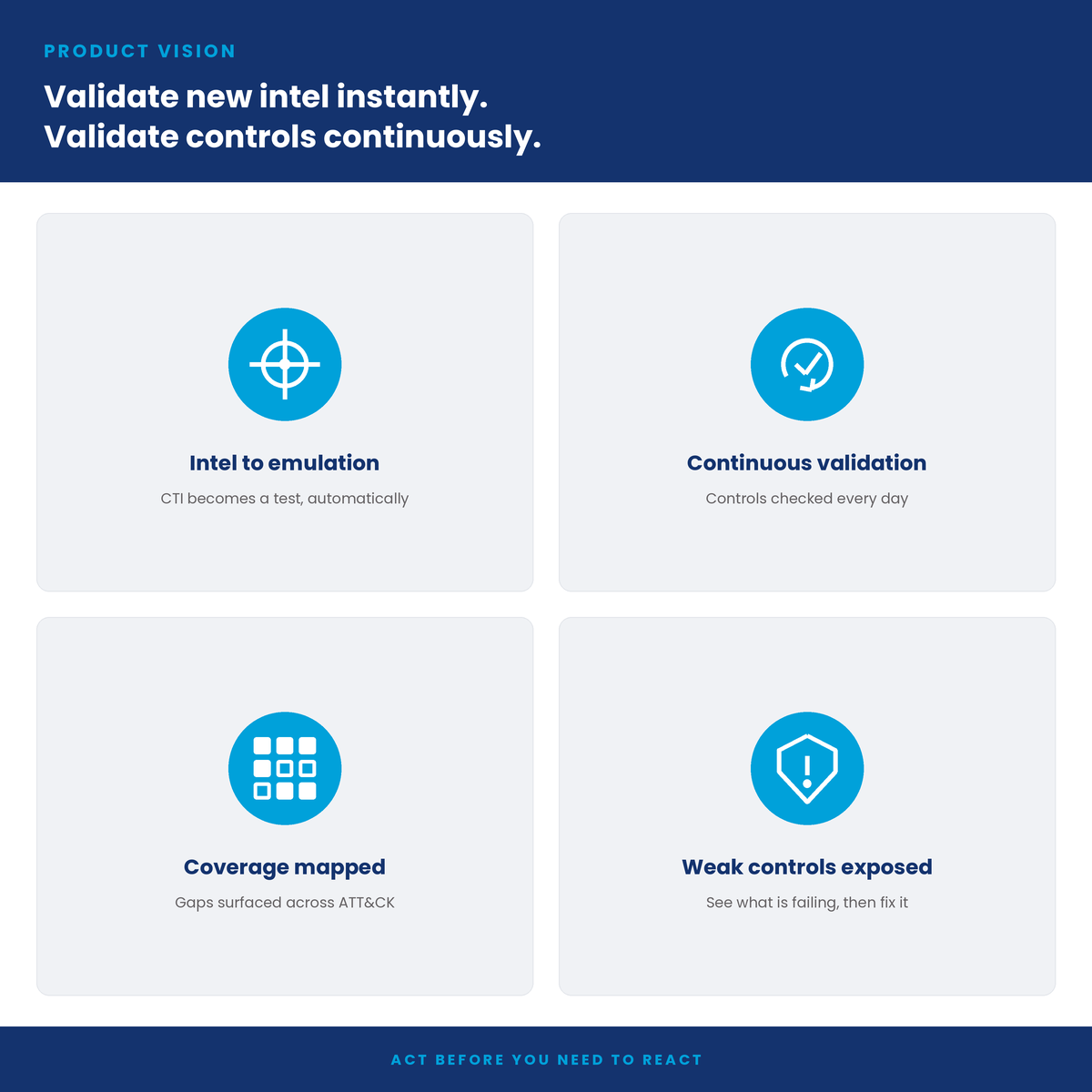
Threat-informed defense only works if it keeps pace with two things at once: the adversary, and your own environment. Here is where we are taking SCYTHE, and why.
Every week, threat intelligence teams learn exactly how the latest adversary operates. And every week, that knowledge sits in a report while the question that actually matters goes unanswered: would we stop it?
That gap, between knowing about a threat and proving you can defend against it, is where most security programs quietly lose ground. Closing it by hand does not scale. The intel arrives faster than any team can turn it into tests, and the controls you proved effective last quarter do not stay that way on their own.
Pillar one: turn threat intel into validation the moment it lands
A new CISA advisory or a fresh STIX bundle should not start a multi-week project. It should start a test. Feed SCYTHE the intel and the platform reads the reported behavior and assembles the emulation for you: the IOCs, the full kill chain mapped to MITRE ATT&CK, and a runnable adversary emulation that mirrors how the actor actually operates.
Below, a Volt Typhoon emulation generated directly from a CISA advisory, complete with the technique-by-technique kill chain and the source intel attached. What used to be a manual translation from prose to procedure becomes an artifact you can run the same day the report drops.
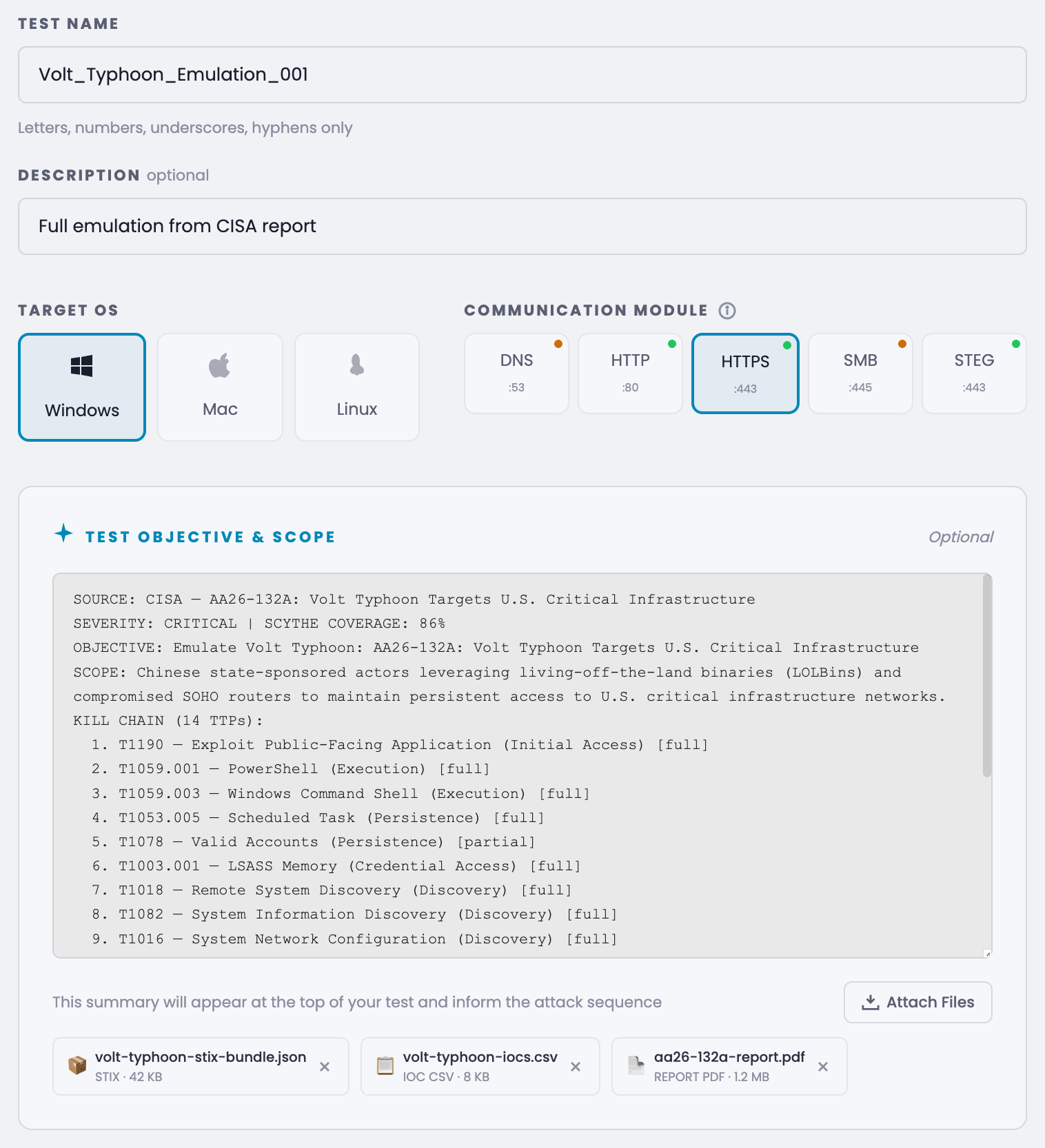
From a CISA advisory to a runnable 14-step emulation, generated automatically from the intel.
Running it is only the start. The value is in what it exposes. AI-driven test generation lets you assess coverage broadly and quickly, so thin spots surface as a map rather than a hunch. You can see which ATT&CK areas carry the most unaddressed techniques, and which deployed tools are underperforming against the behaviors that matter.
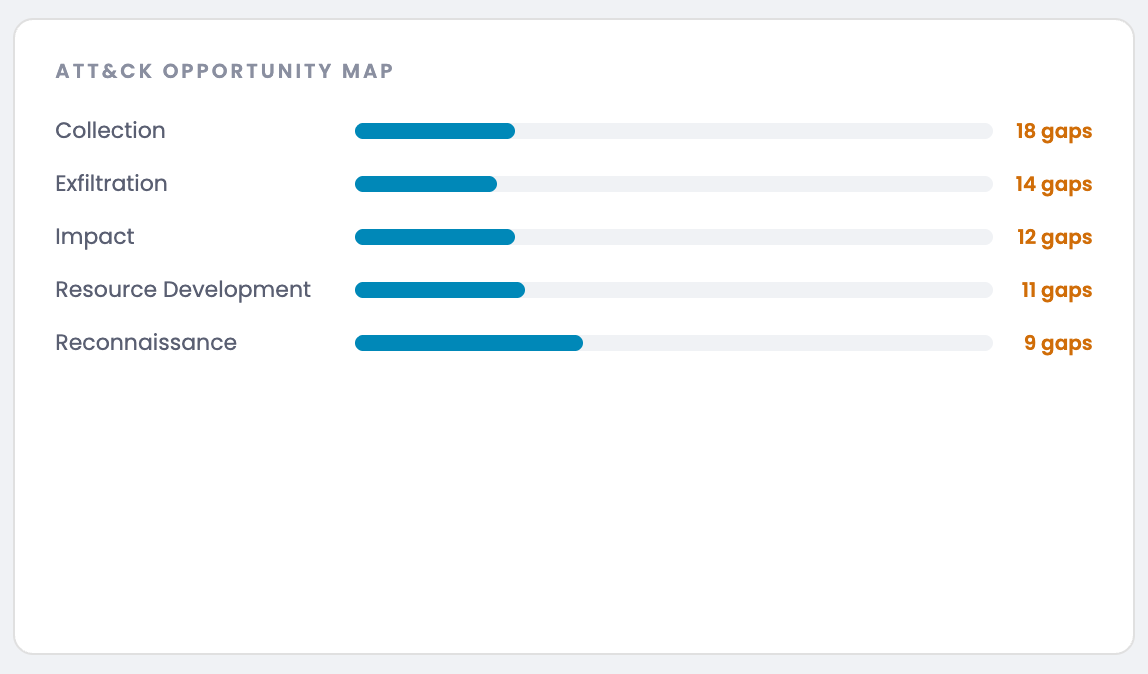
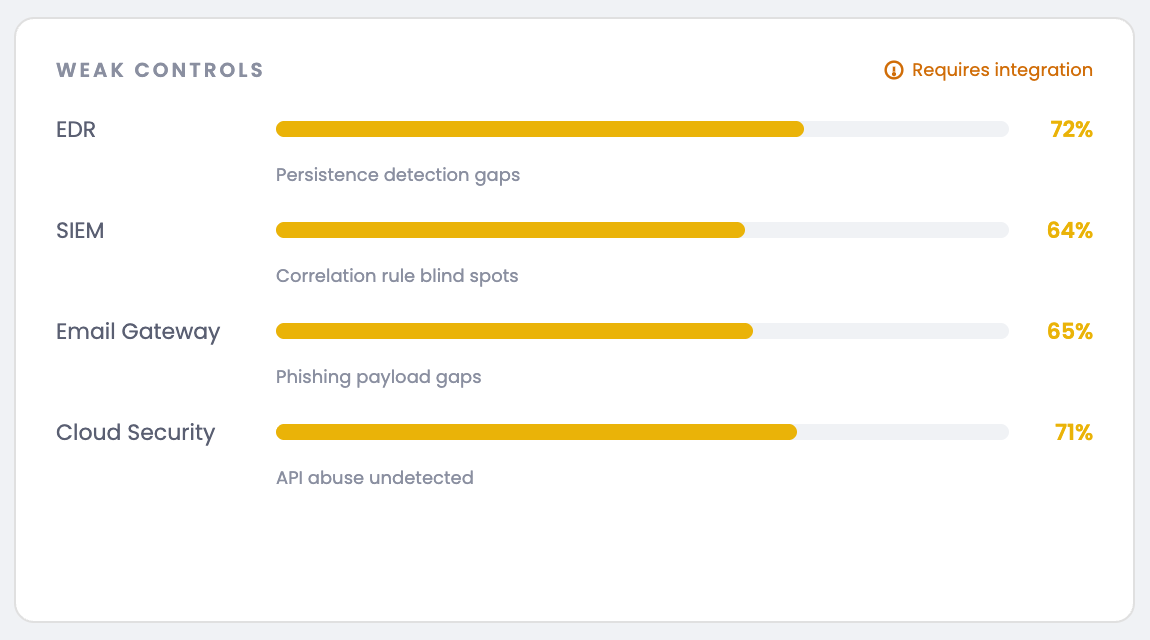
Coverage gaps mapped to ATT&CK, and the specific controls underperforming against them. Every confirmed exposure is one fewer an attacker can use.
Pillar two: validate deployed controls continuously
Validating new intel once tells you where you stand today. It says nothing about tomorrow. Environments change constantly. Configurations drift, an agent stops reporting, a noisy rule gets tuned into silence, a cloud policy is loosened for a project and never tightened again. None of that announces itself, and a point-in-time assessment cannot catch it. By the time you find out, the gap has been open for weeks.
Continuous control validation closes that window. SCYTHE runs detection and alerting tests against your live stack on a schedule, tracks pass, degraded, and missed results over time, and measures mean time to detect so you can see effectiveness eroding before an incident does it for you.
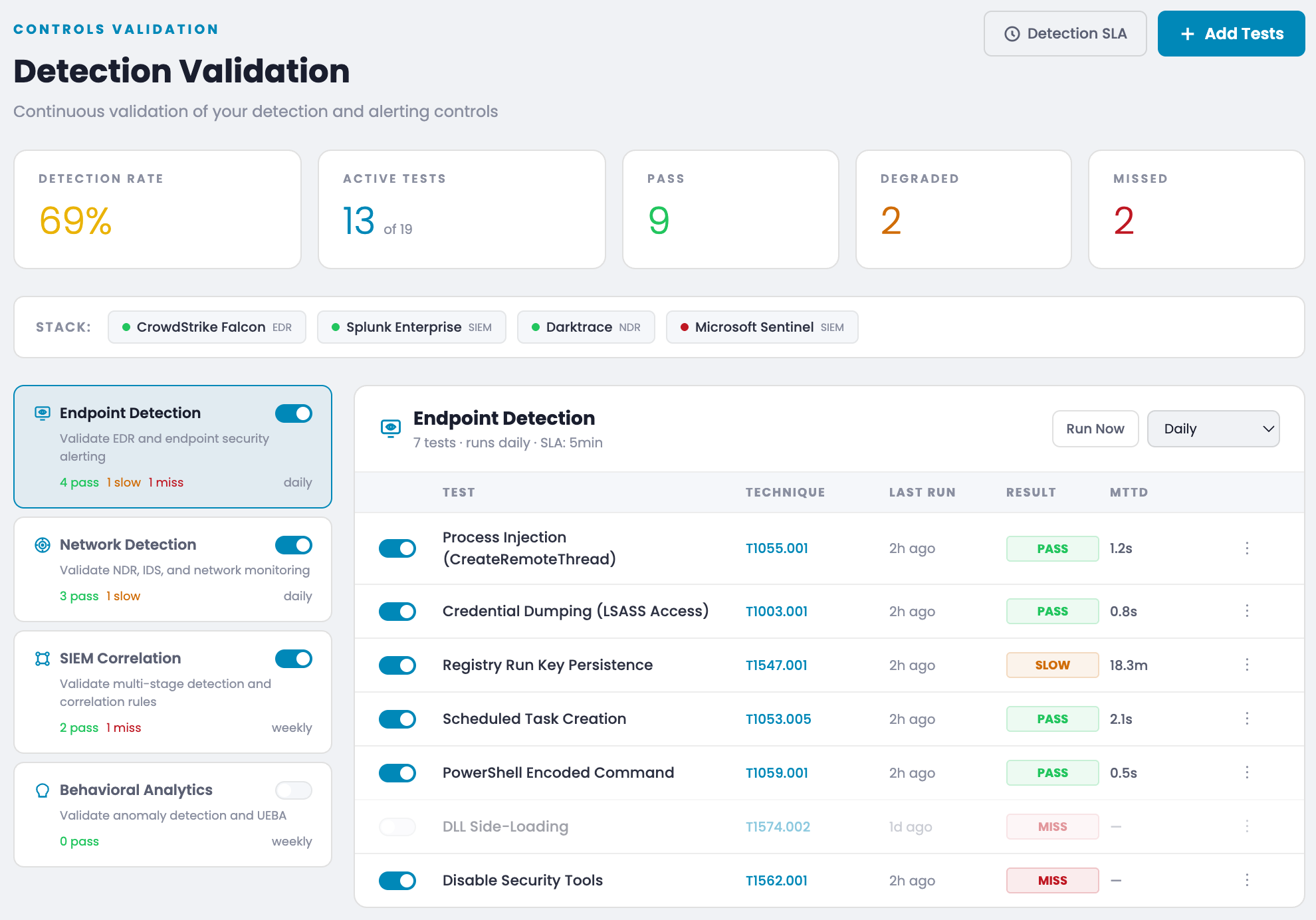
Detection validation running continuously across the stack, with pass, slow, and missed results and detection SLAs tracked per technique.
Two motions, one defense
These are not two products. They are two motions of the same discipline. New threat intel gets validated immediately, so emerging techniques are tested the day they are published. Deployed controls get validated continuously, so exposures from drift are caught as they form. Together they keep your picture of readiness current against both the threats outside and the changes inside.
That is the answer to the question leaders keep asking. "Are we protected?" stops being a quarterly guess backed by coverage assumptions and becomes an evidence-based answer you can give on any given day.
What this means for your team
Red teams spend less time hand-building tests from reports and more time on the adversary behavior that demands real creativity. Detection engineers get a prioritized list of where coverage is thin, plus immediate feedback when a new rule actually works. Security leaders get defensible, current evidence of control effectiveness instead of a point-in-time snapshot that ages the moment it is delivered. The whole team does more validated work in less time.
This is where threat-informed defense is going: validation that keeps pace with the adversary and with your own environment, not the audit calendar. Act before you need to react.
Explore the interactive demoLatest Posts
So You Want to Bring AI Into Your Defense
August 10,2026
Why Legacy BAS Vendors Fall Short in AEV
May 08,2026
Related Articles